Peer Review Process
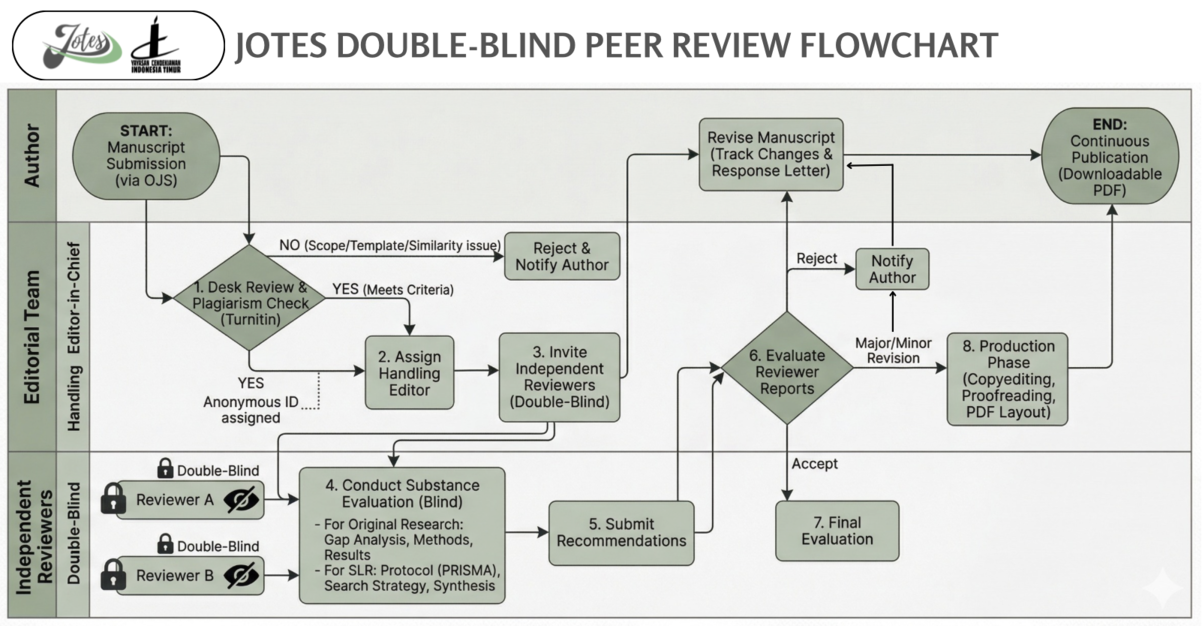
The Journal of Teaching and Education for Scholars (JOTES) strictly employs a Double-Blind Peer Review system. Every manuscript submitted to JOTES is subject to a rigorous, transparent, and objective evaluation by independent experts in the field of education. This process ensures the academic suitability, validity, novelty, and contribution of the published papers.
The peer review process at JOTES proceeds through the following structured steps:
1. Submission of Paper
The corresponding author must submit the manuscript exclusively through the JOTES Open Journal System (OJS). To maintain administrative order and quality control, submissions via email or WhatsApp will strictly not be processed.
2. Desk Review & Plagiarism Check (Editor-in-Chief)
Upon submission, the Editor-in-Chief conducts an initial appraisal. The manuscript is evaluated against the journal’s focus and scope, structural formatting (JOTES template), word count (4,000–8,000 words), and citation style (APA 7th Edition). Crucially, the manuscript will undergo a similarity check using Turnitin. If the paper lacks fundamental scientific merit, shows high plagiarism, or falls outside the scope, it will be rejected directly at this stage (Desk Reject).
3. Section Editor Assignment
Manuscripts that pass the desk review are assigned to a designated Section Editor. The Section Editor is responsible for managing the entire peer-review workflow for that specific manuscript to ensure an objective and specialized evaluation.
4. Invitation to Reviewers (Double-Blind)
The Section Editor invites at least two independent reviewers based on their specific expertise and lack of competing interests. Under the double-blind system, the identities of both the authors and the reviewers are strictly concealed from each other throughout the process.
5. The Review is Conducted
The reviewers critically evaluate the manuscript's scientific substance.
-
For Original Research Articles, the assessment covers the abstract, gap analysis in the introduction, replicability of methods, robustness of results, depth of discussion, and validity of the conclusion.
-
For Systematic Literature Reviews (SLR), reviewers evaluate the systematic protocol (e.g., PRISMA), search strategy, critical appraisal, and the synthesis of the findings. Reviewers provide point-by-point constructive feedback and submit a recommendation: Accept Submission, Require Minor Revisions, Require Major Revisions,or Decline Submission.
6. Editor Evaluates the Reviews
The Section Editor considers all returned reviews. If the reviews differ significantly, the editor may invite a third independent reviewer to obtain a tie-breaking opinion before making an overall recommendation to the Editor-in-Chief.
7. Decision and Author Revision
The editorial decision is communicated to the corresponding author via an official email, accompanied by the anonymous reviewers' feedback. If revisions are required, authors must revise the manuscript using the "Track Changes" feature and systematically address all reviewer comments in a formal Rebuttal/Response Letter. The revised manuscript must be resubmitted via OJS within the given deadline.
8. Final Evaluation and Production
The Section Editor evaluates the revised manuscript to ensure all feedback has been adequately addressed. Once officially Accepted, the manuscript moves to the Production Stage for copyediting, English proofreading, and PDF layout formatting.
9. Publication
JOTES follows a continuous publication model. The fully formatted article will be published and made freely available online as a downloadable PDF in the upcoming issue (May or November).